Doctors at Seoul National University Bundang Hospital (SNUBH) have developed a new method to predict a patient’s parathyroid hormone (PTH) levels after thyroid surgery, using a fluorescent dye during the operation.
A research team led by Professors Choi June-young and Lee Ja-kyung of the Department of Surgery at SNUBH developed a way to estimate postoperative PTH levels early during bilateral axillo-breast approach (BABA) robotic total thyroidectomy.
,_이자경_교수(오른쪽).jpg)
Professor Choi June-young and Lee Ja-kyung
The team used a fluorescent dye and the camera on a surgical robot to check the blood supply to the parathyroid glands, four tiny glands behind the thyroid that help regulate calcium levels in the blood.
The glands can be damaged during thyroid surgery because they are small and difficult to distinguish from surrounding tissues. Even when a gland is preserved, damage to its tiny blood vessels can affect its function.
In the new method, the doctors used indocyanine green (ICG), a fluorescent dye, to identify how many parathyroid glands had adequate blood flow during surgery. This information was then combined with the patient’s PTH level measured before surgery to calculate an expected PTH level after surgery.
The predicted PTH levels showed a significant correlation with the levels actually measured after surgery. In 73 percent of patients, the difference between the predicted and measured PTH levels was within ±5 pg/mL.
Currently, parathyroid function is generally assessed after thyroid surgery through blood tests measuring PTH and calcium levels. The newly developed method could allow doctors to assess the risk of postoperative parathyroid dysfunction earlier and help guide individualized monitoring and calcium and vitamin D supplementation.
“With further validation, this method may serve as a useful supplementary indicator for identifying patients at higher risk of postoperative parathyroid dysfunction and for guiding individualized calcium and vitamin D supplementation and monitoring,” said Professor Choi.
The study was published in the international journal Surgical Endoscopy.
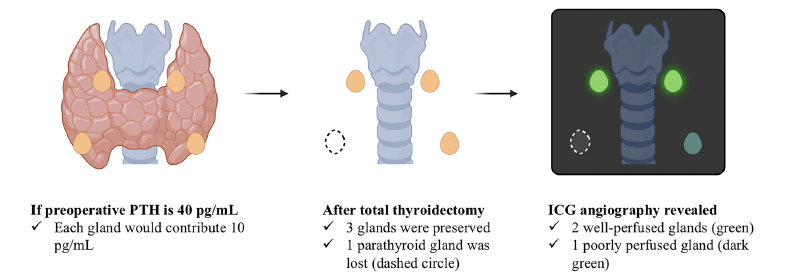
The model scores each of four parathyroid glands by ICG perfusion: well-perfused gives its share of pre-operative PTH, poorly perfused 1 pg/mL, lost 0 pg/mL. ICG, indocyanine green; PTH, parathyroid hormone. (Source: Surgical Endoscopy)
Source: https://www.koreabiomed.com/news/articleView.html?idxno=33110