Seoul National University Bundang Hospital (SNUBH) has begun a government-backed project to connect AI tools across the entire patient journey, from health management before a hospital visit to diagnosis, interhospital care coordination and post-discharge monitoring.
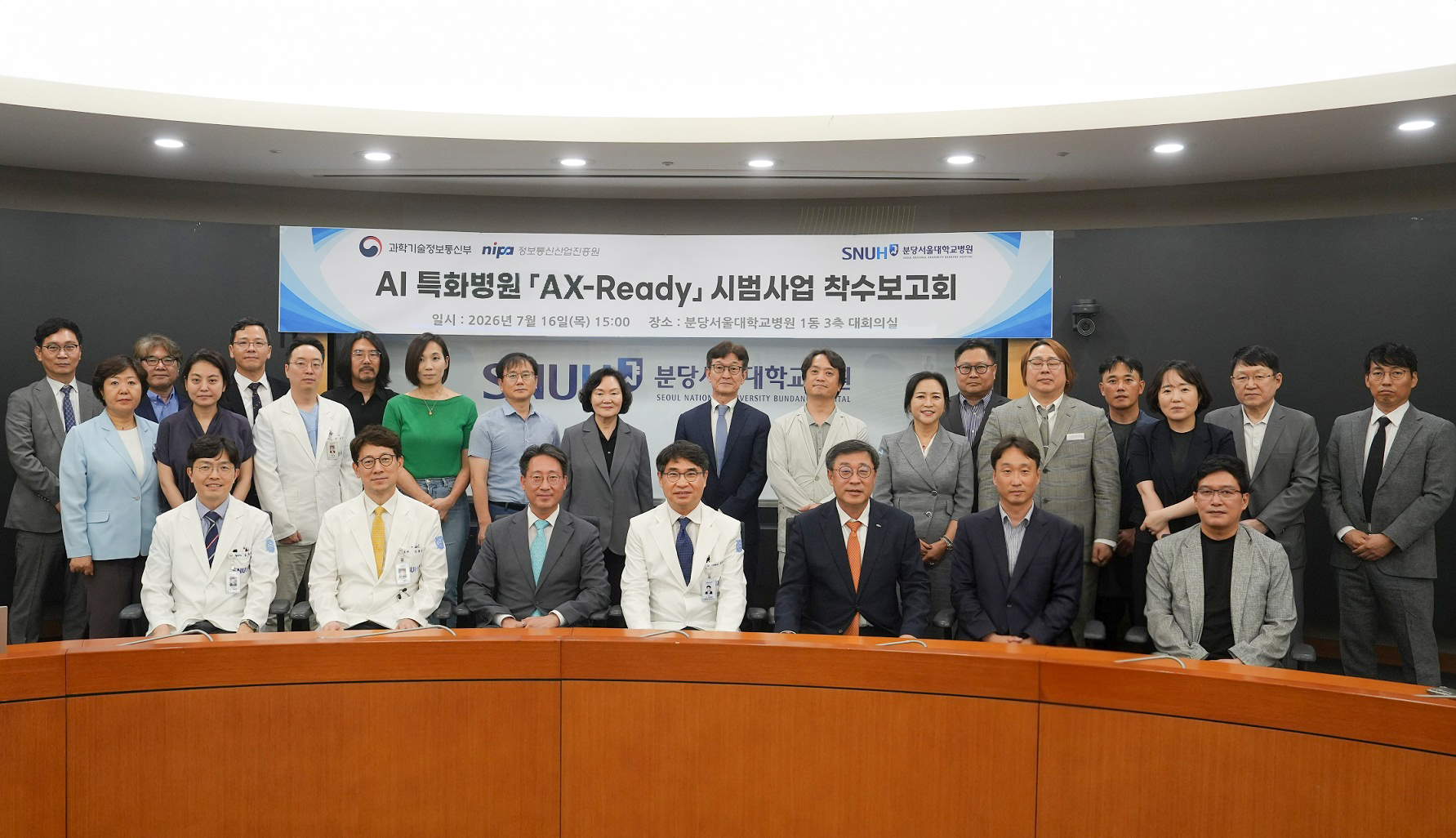
Officials pose for a commemorative photo at the kickoff meeting for the 2026 AX-Ready pilot project for AI-specialized hospitals at SNUBH in Seongnam, Gyeonggi Province, July 16. From left in the front row are SNUBH Chief Information Officer Jung Se-young, SNUBH Chief Planning and Coordination Officer Kim Hong-bin, Ministry of Science and ICT (MSIT) Director General for AI Policy Planning Lee Jin-soo, SNUBH President and CEO Jeon Young-tae, National IT Industry Promotion Agency (NIPA) President Park Yoon-kyu, MSIT AI Industry Team Director Jang Doo-won, and NIPA AI Utilization Department Head Moon Jang-won. (Credit: SNUBH)
The hospital is leading a consortium of 21 institutions under the AI Connected Care Operating Network (AICON), a demonstration project designed to integrate clinical decision-support AI, regional care coordination platforms and hospital automation systems.
SNUBH launched the project with the Ministry of Science and ICT (MSIT) and the National IT Industry Promotion Agency (NIPA) at a kickoff meeting on July 16.
The initiative is part of the government’s 2026 AX-Ready pilot program, which seeks to develop practical models for applying AI transformation, or AX, to regional and essential healthcare services.
Korea had recorded 549 regulatory approvals for medical AI products as of the first quarter of 2026, according to the hospital. However, the use of such products across routine clinical practice remains limited because hospitals differ widely in their data infrastructure and technical capabilities.
Introducing AI systems individually also requires hospitals to bear the cost and technical risk of connecting each product to their existing electronic medical records and other information systems.
AICON aims to address those barriers by allowing multiple hospitals and AI providers to use a shared, standards-based platform rather than building separate systems for each institution.
The consortium includes tertiary and public hospitals, municipal medical centers and local clinics, as well as healthcare IT and AI companies and academic institutions. Participants include Seoul National University Hospital, National Medical Center, ezCaretech, Kakao Healthcare, BIT Computer, Acryl, Puzzle AI and Seoul National University.
The demonstration project consists of three packages.
The first will connect 10 commercially available medical AI products authorized by the Ministry of Food and Drug Safety (MFDS). Instead of using each product as a stand-alone tool, the consortium will link them across different stages of care, including diagnosis, disease management and prognosis prediction.
The second package will establish a regional care coordination platform to support patient referrals and back-referrals between medical institutions.
The platform will include CareNavi, a service for patients, and CarePilot, a service for healthcare professionals. An AI care coordination agent will also help providers share relevant information and determine where patients should receive follow-up care.
The goal is to support a regionally integrated system in which patients can receive appropriate treatment within their communities instead of relying disproportionately on major tertiary hospitals.
The third package will test nine AI-based hospital automation and efficiency solutions. These include voice-based medical record documentation, fall detection systems and an emergency room AI agent.
The systems will be combined to create smart wards that reduce repetitive administrative work and allow medical professionals to spend more time on patient care.
A key feature of the project is its “many-to-many” structure, under which multiple hospitals can connect with multiple AI products through the same platform.
The platform will be based on KR-Core Fast Healthcare Interoperability Resources, or KR-Core FHIR, for healthcare data exchange and the MCP standard for AI connectivity.
Under the existing one-to-one approach, an AI developer generally has to customize its product for each hospital’s information system. Under AICON, an AI system developed according to common specifications could operate at several hospitals without rebuilding the entire interface.
SNUBH said the model could reduce both implementation costs and technical barriers, particularly for smaller hospitals and clinics that lack dedicated AI or data teams.
The consortium also plans to release the resources developed during the project as standard assets that other hospitals can use.
These will include a six-stage onboarding manual for introducing medical AI, a framework for assessing a hospital’s AI utilization maturity and a governance system covering AI security and ethics.
The participating hospitals’ AI maturity will be measured under the same criteria before and after implementation to evaluate whether the systems produce measurable improvements.
“Until now, medical AI has largely been a point technology designed to identify a particular disease,” SNUBH President Jeon Young-tae said. “AX-Ready is an effort to demonstrate a full-stack medical AI model that connects the entire patient journey.”
Jeon said the project should demonstrate that AI can improve patient safety and treatment outcomes rather than introduce technology for its own sake.
“The bottleneck in medical AI utilization is not the technology but the way it is introduced,” said Jung Se-young, SNUBH’s chief information officer and a professor of family medicine.
Jung said AICON’s central objective is to create a structure in which hospitals and AI products can connect through a common platform, enabling regional hospitals and clinics to use the same level of technology available to major medical centers.
SNUBH has received Stage 7 certification, the highest level under the Healthcare Information and Management Systems Society’s Electronic Medical Record Adoption Model, four times.
In 2025, it also became the first hospital in the Asia-Pacific region to receive Stage 7 certification under the latest version of HIMSS’ Analytics Maturity Assessment Model, which evaluates an institution’s ability to use data and AI.
Source: https://www.koreabiomed.com/news/articleView.html?idxno=32670